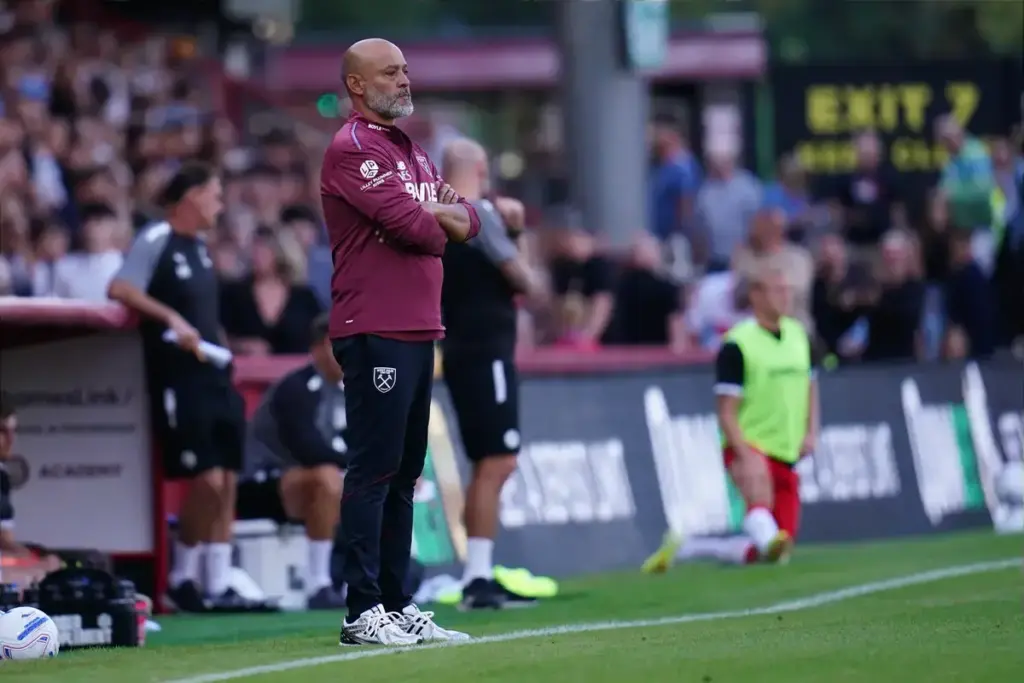

Nuno Espírito Santo has completed his first year at West Ham with a team scoring freely, recovering confidence and still conceding too readily.
The anniversary falls at an awkward point for any verdict. Relegation belongs in the assessment of his first season. September’s improvement deserves recognition in its own right.
West Ham collected two points from their opening three Championship matches. They then took 13 from the next five, scoring 18 goals during that unbeaten run.
That is substantial progress. Whether it becomes the foundation of promotion will depend on Nuno making his side more reliable when their attacking quality cannot settle a match.
Nuno’s West Ham record needs two separate assessments
West Ham’s official profile confirms Nuno took charge on 27 September 2025.
He therefore had most of the Premier League campaign to influence the outcome. The problems he inherited provide context, but relegation remains a failure during his tenure.
His continued presence also means this season carries a responsibility beyond producing more entertaining football. He is managing the attempt to recover the status West Ham lost under him.
Our West Ham managers guide places that task within the club’s wider history. For Nuno, however, the immediate judgment should remain specific: how effectively is he building a side capable of returning?
September supplies a stronger answer than August did.
It would be unreasonable to dismiss four consecutive league victories because of last season. Equally, those results cannot retrospectively turn relegation into an acceptable outcome.
Both parts of his record matter.
September has changed the evidence
West Ham’s opening draws at Burnley and Watford, either side of defeat against Charlton, left Nuno with little room for another slow start.
The subsequent sequence was markedly different.
Across the recorded league results, West Ham beat Wolves 4-2, Derby 3-0, Bolton 3-2 and Wrexham 6-0 before drawing 2-2 at Millwall.
Those five matches produced 13 points from a possible 15.
The distinction between the two periods is useful. West Ham began with four goals in three league games, then scored 18 in five. Their attack became considerably more productive.
Eight matches remain a small sample within a 46-game season. They are enough to demonstrate improvement, but insufficient to establish how the side will respond to sustained injuries, rotation or opponents adapting to their strengths.
The next stage is maintaining results through those less favourable conditions.
Mukasa gives Nuno a reason to trust the rebuild
Divine Mukasa’s contribution provides one of the clearest examples of something working.
His two goals helped secure the breakthrough against Wolves. More significantly, Nuno’s assessment afterwards extended beyond the finishes.
Speaking after the 4-2 victory, as reported by Sky Sports, he said: “The attacking actions today were much more effective and this is the direction we hope for the team.”
Nuno also praised Mukasa’s positioning, distribution and defensive contribution.
That matters because scoring form can fluctuate. A midfielder who helps the team move the ball into useful areas can influence games without appearing on the scoresheet.
Our earlier assessment of Mukasa’s developing role alongside Arne Engels examined that connection between midfield and attack.
For Nuno, the challenge is preserving those relationships while making room for competition. Selecting players on reputation alone would risk overlooking the combinations behind the improvement.
Wrexham showed the attacking potential
The 6-0 victory over Wrexham offered the strongest demonstration of West Ham’s range of threats.
Jarrod Bowen, Joël Piroe, Dinos Mavropanos, Taty Castellanos, Mohamadou Kanté and Manor Solomon all scored.
Six different scorers in one match cannot establish a season-long pattern. It does show why Nuno has options beyond relying on one forward to decide every contest.
The clean sheet was equally useful. West Ham controlled the scoreline at both ends rather than requiring their attack to repair defensive damage.
That should be the standard they try to reproduce, even when six goals are unrealistic.
Comfortable wins also give a manager more freedom to manage minutes. Matches that remain unsettled until the closing stages make that much harder.
Millwall exposed the work still required
The recovery at The Den demonstrated resolve, but the first half remains a problem.
West Ham conceded twice following long throws, a weakness highlighted in the club’s account of Nuno’s post-match assessment.
Their response earned a point. It did not remove the need to examine why they were two goals behind.
Kanté’s impact from the bench gave West Ham renewed attacking momentum before Mavropanos equalised.
Nuno deserves credit for a recovery influenced by a substitute. His broader task is to make that kind of rescue less necessary.
A promotion challenge becomes more dependable when defensive organisation survives difficult spells. West Ham should be able to withstand pressure without needing an exceptional goal or a sudden change of momentum.
What Nuno must deliver in his second year
The assessment after 12 months is mixed, but the next requirements are clear.
Nuno needs to retain the attacking relationships that have improved results, reduce avoidable concessions and make effective use of his midfield options.
The QPR fixture already presents an availability test because Kanté is suspended. It will require a solution that preserves the side’s balance.
Beyond that match, West Ham need evidence that September’s improvement can last.
Nuno now has a productive attack and a recent run of results to build upon. A more dependable defence would give those strengths a better chance of delivering promotion.








Comments.
Loading comments…